Cash in a Coffee Can: America's Roadside Egg Coolers Are Still Betting on You
There's a particular kind of roadside scene that doesn't announce itself. No neon, no parking lot, no guy in an apron waving you in. Just a cooler sitting at the end of a gravel driveway, a sign made from a cut-up cabinet door, and a plastic jar with a few wrinkled bills in it. If you've driven more than twenty minutes outside any American town in the last couple of years, you've passed one. You may have even slowed down, squinted, and thought: is that... eggs?
It is. And in 2026, that cooler is one of the more interesting small institutions going.
A Cabinet Door and a Paint Marker
The signage is almost always the same species of homemade. Letters stenciled in exterior paint, a price that gets revised with a fresh coat of white when feed costs move, and occasionally an arrow pointing to a second cooler because the first one sold out before noon. Somebody's grandkid's handwriting shows up on the weekends. Once in a while there's a laminated note explaining that the hens are molting, so the pickings are slim, sorry.
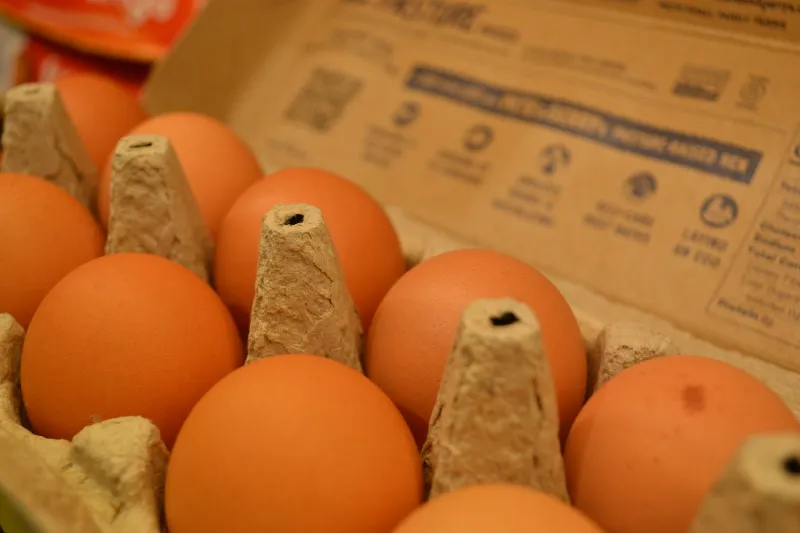
The inventory is equally plain: cartons stacked to the lid, sometimes sorted by size, sometimes not. A few stands have graduated to a small dorm fridge under a tarp or a shelving unit in a repurposed newspaper box. But the cooler remains the workhorse — cheap, weatherproof, and instantly legible to anyone who has ever tailgated.
And then there's the payment situation. A coffee can. A mason jar. A lockbox with a slot cut in the top and a sticker that says THANK YOU in a font lifted from a 1998 word processor.
The Economics Are Slightly Nonsensical
Nobody is getting rich off these things. Do the math on a dozen eggs at five or six bucks, subtract feed, bedding, and the occasional vet bill, and you land somewhere between "hobby that breaks even" and "expensive way to make friends." Many operators will tell you the stand exists to keep the flock from becoming a surplus problem. Hens don't do math; they just lay.
The pandemic-era backyard chicken boom put a lot of new flocks in a lot of new yards, and the egg price chaos of 2025 pushed plenty of people to buy local out of pure sticker shock. What's left behind is a nationwide scatter of small stands, most of them run by people who never intended to become retailers and still don't think of themselves that way.
Which is exactly why the pricing tends to be gentle. Round numbers. No surcharge for card. No upsell.
The Rules You Absorb Without Being Told
There's no posted policy at most stands, but there is absolutely a policy. Regulars know it.
- Bring exact change, or close to it. The jar is not a bank. Making change out of someone's honor box is a mild social felony.
- Put the lid back. Coolers full of eggs in July are a countdown timer.
- Don't dig. Take from the front. Sorting through twelve cartons looking for the perfect dozen marks you as a tourist.
- Return your cartons if the sign asks. A stack of used pulp cartons by the fence is a standing invitation, not clutter.
- Leave the note. Plenty of jars come with a pad of paper. People write "short $1, will catch you Saturday" and they mean it, and they do.
None of that is enforceable. All of it holds.
Somebody Is Always Half-Watching
Here's the part that keeps the whole thing from collapsing: rural roads are not anonymous. The stand belongs to someone whose cousin works at the co-op and whose neighbor drives past four times a day. A camera might catch a license plate, but the stronger deterrent is simpler — the odds that the person shorting the jar is somebody's Sunday school classmate are not small.
That said, the failure rate is low enough that most operators don't bother upgrading past a mason jar. Ask around and you'll hear the same stories: a kid who left an IOU, a traveler who overpaid by ten dollars because they only had a twenty and felt weird about it, a guy who dropped off a bag of tomatoes in August because he felt the eggs were underpriced.
The QR Code Showed Up. The Coffee Can Stayed.
The genuinely new development is the laminated Venmo QR code taped to the inside of the cooler lid. Some stands have gone further — a little cash-app placard, a note asking you to put the payment reference as "EGGS" so it's sortable. It's a small concession to a world where nobody carries fives anymore.
But the jar hasn't gone anywhere. In most cases it's still there, still holding a few bills, still the presumed default. Which tells you something about what the stand is actually for. A card reader would be more efficient. Efficiency isn't the point.
Why People Keep Pulling Over
Part of it is the eggs — genuinely, they're better, and the yolks are the color of a school bus. Part of it is the theater of it, the small jolt of finding an unstaffed business operating in the open. But the bigger draw is harder to name. Handing cash to nobody and trusting that the cooler will be stocked and the carton won't be cracked is a low-stakes civic exercise, and it turns out people like getting a little practice.
Kids especially. There's a whole genre of family road-trip memory that now involves a nine-year-old being handed a five-dollar bill and told to go do the transaction alone. It's a first errand, a first negotiation with the world, conducted at the end of a driveway with a chicken somewhere in the background.
Pull Over Anyway
So if you spot one this fall — a cooler, a marker sign, a jar with a couple of ones in it — treat it like the small occasion it is. Bring singles. Close the lid. Take a dozen, leave the change, and enjoy the brief, strange feeling of being trusted by a stranger who isn't even there to see it.
And if there's a pad of paper, write something nice. Somebody reads it.