Aisle Five, Asleep: The Unwritten Contract Between America's Hardware Stores and Their Cats
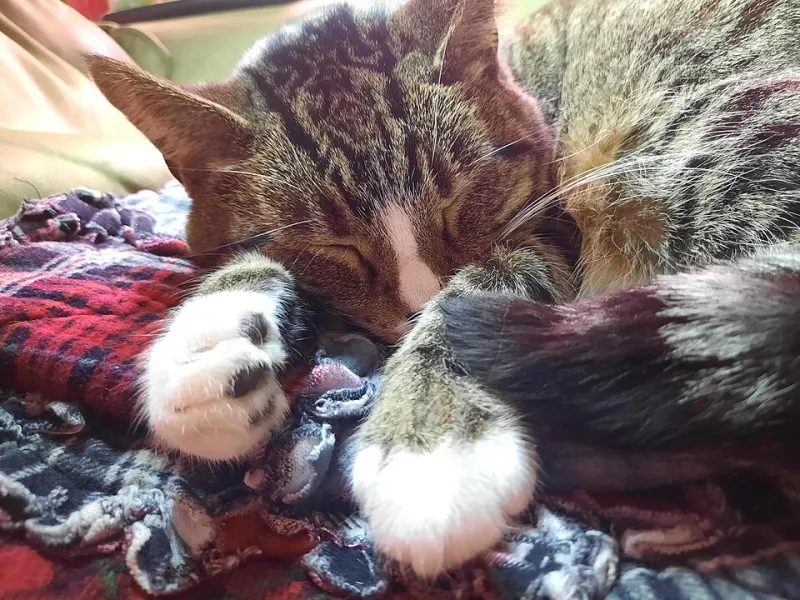
Photo: EDG 543, CC BY-SA 4.0, via Wikimedia Commons
You smell the place before you see it — cedar shavings, machine oil, the ghost of a thousand keys cut. Then you round the endcap of bird feeders, and there he is. A gray tabby, roughly the shape and density of a sack of sand, sprawled across a stack of burlap like he's got a lien on it.
Nobody introduces him. Nobody has to. You just step over the tail and get on with your business, because you have figured out, in about four seconds, how this store works.
The Job Description Nobody Wrote
There is no personnel file for a hardware store cat. There's no onboarding, no performance review, no nametag — although more than one store has zip-tied a tiny collar tag that says something like "Employee of the Month, 2019–Present."
The actual duties are pretty well understood. Mice get into birdseed, grass seed, fertilizer, and the burlap sacks that hold all three. A cat fixes roughly 90 percent of that problem just by existing and smelling like a cat. The remaining 10 percent is handled at night, quietly, and the store does not ask for details.
But pest control is the official résumé line. The real job is harder to write down. The cat is a greeter who never says a word. It's a conversation starter for the shy guy buying two bolts. It's the reason a five-year-old will tolerate twenty minutes in the plumbing aisle while Dad hunts for a washer that fits.
Most of these cats arrive sideways. Somebody's cousin's barn cat had a litter. A customer brought one in a cardboard box in November and the owner said "just for the weekend" — a sentence that has never once been true. A few come from shelters, adopted out with a wink and a warning: he's not much for laps, but he's hell on mice.
The Rules of Engagement
There's no posted policy, but every shopper seems to intuit the same small set of rules within seconds. Here's the field guide.
Let the cat come to you. Hand out, low, palm down. If he doesn't move, that's a complete answer. Do not wake him. He's been on shift since opening.
Ask before you pet. Actually, just ask "Is he friendly?" and prepare for a full biography, including his age, diet, sleeping habits, and the story of how he lost the tip of one ear.
Do not feed him. Every store owner will tell you the same thing: the cat is on a diet, the cat has already been fed, and the cat has additionally been fed by four other customers who thought they were the first.
Do not block the warm spot. That rectangle of sun by the register is not accidental real estate. It has been negotiated over years.
He has the right of way. On the counter, on the floor, on the stack of lumber you were hoping to buy from. Pick a different stack.
Don't let him out. This is the big one. The gap in the sliding door, the loading dock, the moment when your arms are full of PVC pipe — that's when a hardware store cat makes his break for freedom and the entire staff goes into a coordinated search that has the emotional texture of a fire drill.
Why a Sleeping Cat Reads as Trust
Here's the odd part. A cat asleep on the counter is not a sales tactic. It sells nothing. It can't be optimized, upsold, or A/B tested. And yet it functions as one of the most reliable trust signals a small retailer has left.
Think about what it tells you. Somebody is here every day to feed it. The store isn't so thin that it can't afford a bag of kibble and a vet visit. The owner isn't an absentee landlord three states away — this is a person who has, at minimum, a cat's worth of skin in the game. The place has been open long enough for a living creature to grow old in it.
In 2026, with the retail landscape consolidating into a handful of apps and a handful of big boxes, that little scene is doing a lot of quiet work. It's a piece of non-monetized warmth in a world that has mostly run out of it. You can't put a rewards program on a tabby. That's exactly why it means something.
The Big-Box Problem
The chains can't really do this. Corporate risk and health-code caution mean most national retailers won't have a resident animal, and honestly, the logistics would be a nightmare. A few chains have tried the cat-adjacent route — adoption weekends, partnerships with local shelters — and they're good programs, genuinely. But a rescue pop-up on a Saturday is a moment. A cat asleep on a feed sack is a fact.
Independent stores get away with it because non-food retail is generally more permissive, and because the local inspector has probably known the cat for six years and calls him by name. The system works because nobody formalizes it. The moment you write it down, somebody in compliance reads it.
The Quiet Agreement
So here's what the cat is actually trading. The store provides a warm spot, a bowl, and a lifetime supply of people who will tell him he's handsome. The cat provides the smell of cat, a reason to linger, and a piece of living furniture that makes a room full of pipe fittings feel like a place where humans work.
And the shopper? The shopper provides the third leg of the deal, which is simply this: you walk in, you nod at the cat, you buy your two bolts and your roll of tape, and you don't make a thing of it.
That's the whole agreement. Nobody signed anything. It has held for decades.
In an era of same-day delivery and app-based everything, the most reliable loyalty program in town still has four paws, no points, and absolutely no interest in your business.
Which is, somehow, the reason you keep coming back.