Masking Tape and Mushroom Soup: Field Notes From the Neighborhood Casserole Circuit
There is a particular sound a glass baking dish makes when it slides across a car seat: a low, ceramic-ish scrape, followed by the soft slosh of something creamy under foil. If you grew up in a certain kind of American town, that sound means somebody died, somebody had a baby, or somebody just moved in next door. It is the sound of dinner arriving uninvited and entirely welcome.
Lately, that sound is turning up more often. Not because of any marketing push — nobody is running ad campaigns for the insulated carrier bag — but because a lot of people spent the last several years staring at their phones and concluding that a text that says "let me know if you need anything" is not, in fact, anything. A pan of baked ziti, on the other hand, is a complete sentence.
The label is the message
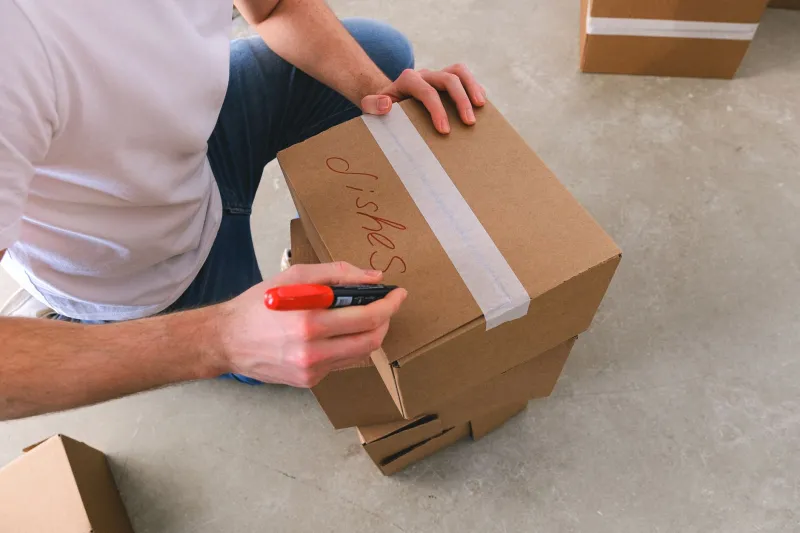
Walk into any kitchen where a casserole is being prepped for delivery and you'll find the same artifact: a strip of masking tape pressed to the lid or the foil, with a name and a reheating instruction in ballpoint. Margaret — 350 for 25 min. Take foil off last 10.
That piece of tape is doing more work than it gets credit for. It's a claim of authorship (this is my dish, this is my grandmother's recipe, I am not anonymous). It's a manual. It's a small, unglamorous contract: I made you food, you don't have to guess, and eventually you'll return the pan.
People who study foodways love to point out that the handwritten note is the original push notification. Fine. But the more practical observation is that tape sticks to glass better than it sticks to anything else, which is why the whole system has stayed essentially unchanged since the era of the avocado-green kitchen.
A short, unscientific history of the carrier
Before the bag, there was the towel. Before the towel, there was a person holding the dish with oven mitts and driving very, very carefully.
The insulated carrier as we picture it — the quilted rectangle with the zipper that goes around three sides, usually in a floral or a geometric print that has never once been fashionable — emerged as a staple of mid-century church suppers and potluck culture. The patterns are dated in the way that all genuinely useful objects eventually become dated. There's a reason the same carriers keep turning up at estate sales, still structurally sound, still smelling faintly of somebody's pantry.
What's changed in 2026 isn't the design. It's the willingness to use it. For a while there, disposable aluminum pans and meal-delivery apps did a lot of the work that a covered dish used to do. Convenient, sure. But a foil pan from the store says "I ordered this." A glass dish in a quilted bag says "I stood in my kitchen." Those are different messages, and people have started to notice the difference again.
Regional variations nobody agrees on
The casserole circuit is one of the few remaining things in America that is genuinely local, which means every region has strong opinions and none of them can be proven correct.
In parts of the upper Midwest, the Lutheran church cookbook is the governing document, and a hot dish without a cream-of-something base is viewed with mild suspicion. In the South, the delivery is often two-part: the main dish plus something wrapped separately so it doesn't go soggy, and the deliverer will absolutely mention the separation out loud. In parts of the Northeast, you may receive a pan of baked mostaccioli with a name nobody can spell consistently, and the real gift is the sauce recipe that will never be shared in full.
Then there's the great macaroni-and-cheese schism. Some families consider it a side dish and are slightly offended when it shows up as the entrée. Others consider it the only thing you should ever bring to a house with children in it. Both groups are sincere. Neither will be moved.
And then, of course, there is the Jell-O question. It remains unsolved.
The rules nobody writes down
The written etiquette of the casserole is thin. The unwritten etiquette is a full legal code.
A few of the clauses, as best anyone can reconstruct them:
- Never return an empty pan. It comes back washed, or it comes back full. An empty Pyrex on a porch is considered a small rudeness.
- Don't ask what's in it. If allergies are relevant, that information travels ahead through the grapevine, not through an interrogation at the door.
- Keep the visit short. The delivery is the point. Standing in the doorway for forty minutes while someone's family is grieving is not the point.
- Don't bring a dish that requires assembly. The recipient is having a bad week. Your beautiful build-your-own-taco-kit is a chore in a bag.
- Match the size of the gesture to the situation. A new neighbor gets a loaf of something. A funeral gets the good pan.
The masking tape matters here too. Write the reheating instructions. Write your name. It seems fussy, and it is, but it also means the dish can be frozen, rediscovered three weeks later, and eaten without a phone call.
Why it still beats the group chat
There's a reason the casserole keeps outrunning the digital version of the same impulse. A text asking what you need puts the labor back on the person who's already exhausted. A covered dish requires no reply. It just shows up, warm, with instructions taped to the lid, and then leaves.
It's also a rare form of generosity that doesn't scale. You can't mass-produce it, you can't forward it, and you can't outsource it to an app without losing the entire point. Someone has to buy the noodles. Someone has to remember whose pan is whose.
That friction, it turns out, is the feature. The carrier bag is awkward to store, impossible to fold flat, and takes up a shelf nobody has. It's also the closest thing many blocks have to a functioning social contract — one that shows up at the door around six o'clock, still hot, with a stranger's handwriting on the lid.
The return trip
Eventually the pan comes back. It's usually washed, sometimes with a thank-you note tucked inside, occasionally with a new baked thing in it because somebody wanted to keep the chain going one more link.
If you're lucky, you'll look at the tape still stuck to the lid and see two names on it — the original one and a second one written underneath, because the dish has now been through three kitchens and nobody wanted to peel the label off. That's not clutter. That's a ledger.
So if a quilted bag with a floral print has reappeared in your closet this year, don't fight it. Wash the dish, tape a note to the lid, and find somebody on the block who could use a Tuesday dinner. The network is already running. It just doesn't have a login screen.