The Second Fridge: Field Notes From America's Coldest Junk Drawer
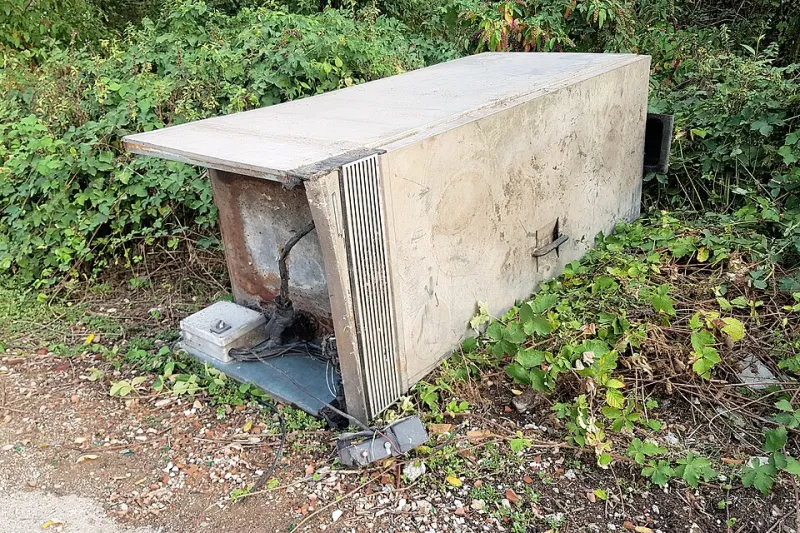
Photo: Mænsard vokser, CC BY-SA 4.0, via Wikimedia Commons
There is a moment in almost every American home-buying story when someone opens the side door, points at the scuffed white box humming against the back wall, and says, with total sincerity, 'We're leaving that.'
Nobody negotiates. The garage fridge isn't part of the sale. It's part of the weather.
Meet the appliance that never got a housewarming
The kitchen refrigerator is a curated object. Matching bins, a wipe-down before guests arrive, produce arranged with intent. It reflects the person you are trying to be.
The garage fridge reflects the person you actually are.
It is the appliance equivalent of the friend who has seen you at your worst and stayed anyway. It lives near the rake. It has a dent from a bicycle handlebar. Somewhere on the front, a magnet for a plumber who retired during the Obama administration is still holding up a takeout menu you will never call.
And it is, by any honest measure, one of the most American objects in the house.
Inside the door shelves: a condiment inventory
If you want to understand a household, skip the photo albums. Open the garage fridge and count the mustards.
There will be at least four. Possibly six. One is yellow, one is stone-ground, one came home from a vacation rental by accident, and one has a label so faded it could be anything. Nobody throws them out because each is technically still functional, and throwing out a condiment feels like giving up on a future self who might suddenly want horseradish.
Then come the shelf-stable items that people refrigerate anyway out of pure superstition: soy sauce, hot sauce, maple syrup, a jar of pickles with two pickles left, and a bottle of something labeled 'Dad's sauce' with no date and no further explanation.
The door of the garage fridge is where good intentions go to chill. Salad dressing bought during a January health kick. A jar of salsa from a party in a different season. Three kinds of barbecue sauce, all of them the favorite of somebody in the family, which is why none can be discarded.
The freezer: a permafrost of good intentions
The freezer compartment is a different civilization entirely.
Here you will find a plastic bag containing what appears to be a single frozen pork chop, wrapped in a manner suggesting it was packed during a power outage. Beside it, a zip-top bag of unlabeled red sauce. Beside that, a frost-encrusted package of bratwurst from a cookout whose attendees have since graduated from college.
Somewhere in there is the emergency ice. Not the good ice. The emergency ice — the bag that has fused into a single translucent boulder and is now structurally part of the appliance.
And then there's the deer. In much of the Midwest and South, the garage freezer is a licensed processing facility, and November brings a supply of venison wrapped in white butcher paper and Sharpie. Ask a Wisconsin family what's in their second freezer and you may get a number.
The unwritten rules
The garage fridge operates under a legal code no one wrote down but everyone obeys.
Rule one: the kitchen fridge is for eating. The garage fridge is for holding.
Rule two: anything without a date gets a pass. Anything with a date that has passed gets a sniff, then a pass anyway, because garage-fridge logic holds that cold is cold.
Rule three: beverages are communal, except the ones that aren't. Every garage fridge has an emergency soda stash, and every family has one person who will notice if a can goes missing.
Rule four: nobody is allowed to comment on the state of the garage fridge unless they are prepared to clean it.
Rule five: the fridge belongs to whoever restocks it, and that person is usually a dad, or a mom acting as a dad, and they would like a small amount of credit.
Regional variations on a national habit
In the South, the second fridge often lives on a screened porch or carport and gets pressed into service as a boiling-peanut holding tank, a holiday overflow unit, and a place to chill a watermelon the size of a toddler.
In the Southwest, garage heat is the enemy, and the second fridge is either upgraded to something serious or replaced every few summers with the cheerful resignation of a person buying a fourth lawnmower.
In the Northeast, the second fridge is often a basement fridge, and it is less a lifestyle choice than a compromise with a house built in 1928.
And everywhere, the second fridge is where Thanksgiving goes when it doesn't fit. For three days in November, it becomes the most important appliance in the county.
Why we keep it
The honest answer is that the garage fridge is a time capsule that happens to keep things cold. It's where the leftovers of your former self live: the hot sauce from the trip, the frosting from the birthday, the casserole from the neighbor who moved away. Throwing it all out would mean admitting that those versions of your life are finished.
So it hums. It gathers. It holds one more bag of ice, one more jar of pickles, one more thing nobody wants to decide about.
And someday, when you sell the house, you'll open the side door, point at it, and say the only thing that makes sense.
'We're leaving that.'