Stuck-On Sociology: Reading a Town Through Its Rear Windows
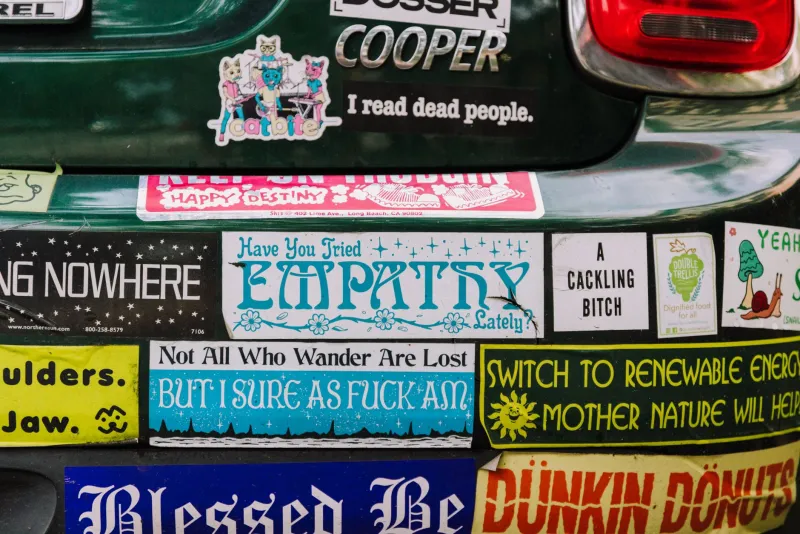
There is a certain kind of American anthropology that requires no grant funding, no clipboard, and no conference badge. You just need a parking lot, a little patience, and the willingness to look at the back of other people’s cars.
The bumper sticker is not dead. In 2026, when nearly every opinion, milestone, and pet photo can be uploaded, filtered, and forgotten before lunch, the rear window remains a weirdly permanent bulletin board. It is analog, sun-faded, and often applied slightly crooked. It is also one of the last public spaces where people decorate without asking a platform for permission.
The Tailgate as a Rolling Neighborhood
A bumper sticker is a tiny declaration of belonging. Sometimes it is literal: a school logo, a youth soccer club, a hometown zip code. Sometimes it is emotional: a paw print and a date, a ribbon for a cause, a slogan that sounds like a family inside joke. And sometimes it is pure stubborn personality, like a faded sticker for a radio station that changed formats two decades ago.
On a recent drive through a mid-sized town, I started counting. Not scientifically. More like a person who has decided the grocery store parking lot is a museum with better snack options. In one row alone, I spotted a basset hound decal, a sticker for a elementary school fundraiser, a “Don’t Tread on Me” patch, a rainbow flag, and a faded oval that said something about a beach I could not quite identify. That is not a political science seminar. That is a neighborhood meeting conducted in adhesive.
The genius of the bumper sticker is that it is low-stakes and high-visibility. You do not have to knock on a door. You do not have to start a podcast. You just merge onto the highway and let the back of your car do the talking.
What the Parking Lot Knows
If you want to read a town quickly, skip the welcome sign and go where the cars are idling. The high school lot tells you what the booster club is selling. The trailhead parking area tells you whether the local identity leans hiking boots or disc golf. The church lot tells you which vacation Bible school is currently winning the signage race. The Walmart lot tells you everything else, often at once.
This is not about judging people by their vehicles. It is about noticing how people choose to introduce themselves when they are not face to face. A bumper sticker is a handshake from twenty feet away. It says: here is a thing I care about, a place I have been, a dog I miss, a kid I am proud of, a joke I still think is funny.
In 2026, that matters more than it might seem. Most of our daily signals are algorithmic. The bumper sticker is not. It cannot go viral. It cannot be ratioed. It cannot be edited after the fact, unless you count peeling it off with a razor blade and a lot of regret. It just rides around, collecting dust and sunlight, slowly becoming part of the local landscape.
The Fundraiser Decal Is Still Undefeated
Every town has its own sticker economy. The school fundraiser decal is the quiet champion. It costs a few dollars, supports a marching band or a robotics team, and turns the family minivan into a mobile donation receipt. You see them clustered outside pickup lines, soccer fields, and the one pizza place that sponsors everything.
Then there are the pet memorials. A small paw print. A name. Sometimes a date range that makes you swallow hard in the school pickup line. These are not bumper stickers in the traditional sense. They are tiny roadside shrines, except the road is wherever that car happens to go. You do not need to know the dog. You know the feeling.
And then there are the inside jokes. The stickers that make no sense to anyone outside a five-mile radius. A mysterious abbreviation. A cartoon vegetable. A phrase that probably originated at a backyard cookout in 2011 and has never been explained since. These are my favorite, because they are proof that not everything needs to be legible to strangers. Some things are just for the people who know.
Why the Sticker Still Sticks
It would be easy to assume the bumper sticker is fading out. After all, we have apps for everything. We can announce our identities in better fonts. We can curate our lives with more precision. But precision is not the point. The bumper sticker thrives because it is imperfect. It bubbles. It peels. It gets rained on. It says something sincere in a font that was probably chosen in a hurry.
There is also the geography of it. A sticker from a national park means you went there. A sticker from a local brewery means you live near it, or you visited, or your cousin owns it. A sticker from a college means somebody in that car is either an alum, a parent, or a student who has not yet learned to pack light. These are small travelogues attached to the tailgate.
In a country as spread out as the United States, the bumper sticker becomes a way of carrying place with you. The beach oval. The state flag. The city skyline. The obscure county fair. It is a souvenir that keeps working after the vacation ends. It is also a conversation starter, which is a fancy way of saying it gives strangers something to nod at in traffic.
A Field Guide for the Curious
You do not need to turn this into homework. Next time you are waiting in a drive-thru line or killing ten minutes before a restaurant opens, look around. Notice the stickers. Count the school logos. Find the oldest one. Spot the one that makes you laugh. Wonder about the story behind the paw print.
That is the bumper sticker census. It is not official. It is not accurate. It is not going to be published in a peer-reviewed journal. But it is a genuinely good way to feel connected to a place you are just passing through. It reminds you that the town is not just buildings and road signs. It is a bunch of people with opinions, memories, dogs, kids, causes, and jokes, all stuck to the back of their cars and sent out into the world.
And in 2026, that is still worth reading. Especially if you are stuck behind them at a red light.