The Diner Placemat Is the Last Newspaper You Actually Finish
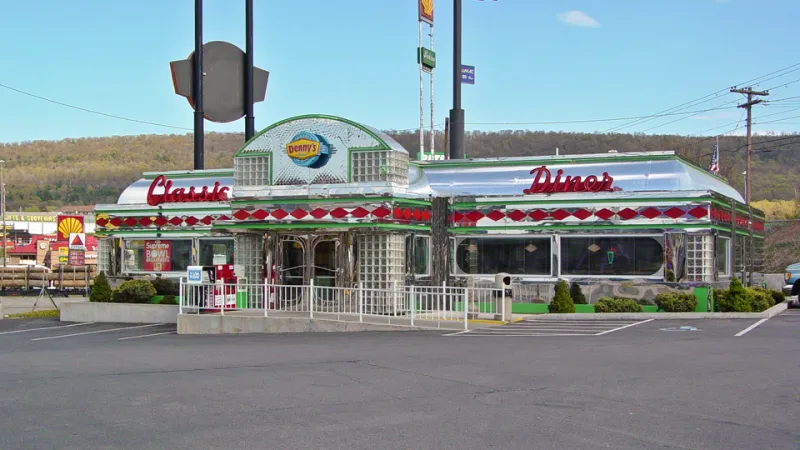
Photo: Ben Schumin, CC BY-SA 2.0, via Wikimedia Commons
The first thing that arrives at a good diner is not the coffee. It is the placemat. It lands on the table with a soft slap, usually slightly sticky, often printed in two colors, and almost always featuring a drawing of a cow, a tractor, or a cartoon sun wearing sunglasses. If you are lucky, there is a maze on the back. If you are very lucky, there is a coupon for a tire rotation.
We do not talk about the diner placemat enough. It is disposable, cheap, and designed to be covered in syrup within four minutes. But it is also a tiny local newspaper. It has a front page, a puzzle section, a map, and ads. It has a point of view. It has a town on it. And unlike almost every other form of media in 2026, people actually read it.
The Front Page Arrives With Crayons
The placemat is the only newspaper that gets handed to a child with a crayon and no explanation. That alone makes it culturally significant. A kid who would never read a town newsletter will absolutely read a placemat if it has a maze and a drawing of a chicken. A parent who has not looked at a local paper in years will absolutely read the ad for the flooring store because it is right there under the salt shaker.
The content is not trying to be important. That is its advantage. A placemat does not need a lede. It does not need a paywall. It does not need a comment section. It needs a word search, a cartoon, a map with a star that says 'You Are Here,' and a promise that the chicken fried steak is homemade. It is local media at its most frictionless.
A Field Guide to Placemat Media
If you start paying attention, you can classify diner placemats the way a birdwatcher classifies finches. There is the classic kids' mat: a maze, a tic-tac-toe board, a drawing of a plate with a face, and a word search where every word is a breakfast item. There is the local-history mat: a paragraph about the town's founding, a sepia photo of a train depot, and a sentence about a flood in 1937. There is the scenic mat: a badly proportioned map of the county, with arrows pointing to a lake, a casino, and a meat market. And there is the ad-heavy mat: a grid of businesses, each one more specific than the last, from 'Bobby's Transmission' to 'Sue's Hair and Tanning.'
The ads are the best part. They are not targeted. They are not data-driven. They are there because the owner knows the diner owner, or because the diner owner knows the owner, or because somebody's cousin printed the mats and threw in a discount. The ads are for businesses that still exist in the town, which is more than you can say for a lot of digital media. A placemat ad is a small vote of confidence in the local economy.
The Map Is the Masterpiece
Every great diner placemat has a map. It is usually drawn by hand, or by someone who owns an old copy of clip art. The roads are not to scale. The landmarks are not labeled correctly. The 'You Are Here' arrow is always a little off. But the map tells you something a GPS cannot: where the locals think you should go. It points to the fairgrounds, the river access, the best place to buy sweet corn, and the diner itself. It is a treasure map drawn by someone who has never used a compass but has lived in the town for forty years.
That map is also a community archive. It records which businesses were open when the mat was printed. It records the shape of the town before the bypass was built. It records the fact that there used to be a drive-in theater and now there is a storage facility. If you collected enough placemats from enough diners, you could reconstruct the commercial history of a region one breakfast at a time.
Why It Still Works
The diner placemat survives because it is not trying to be anything other than useful. It keeps the table clean. It entertains a kid. It advertises a muffler shop. It gives you something to look at while you wait for your eggs. It does not ask for your email. It does not autoplay a video. It does not care whether you finish it.
That is why it feels like the last honest local newspaper. It is not written by a committee. It is not optimized for engagement. It is just a sheet of paper that tells you a little about the place you are sitting in. And in a country where so much local news has been hollowed out, that is worth noticing.
How to Read One Without Looking Weird
Start with the map. Find the star. Look at the roads you have never taken. Then read the ads. Count how many are for businesses you would actually use. Then do the maze. If there is no maze, do the word search. If there is no word search, read the paragraph about the town's founding. Then order the special. The placemat is not a souvenir, but it is a record. And the best ones are the ones that look like they were printed in a hurry by someone who loves the town anyway.