Sharpie Economics: The Hidden Rules Behind Every Driveway Price Tag
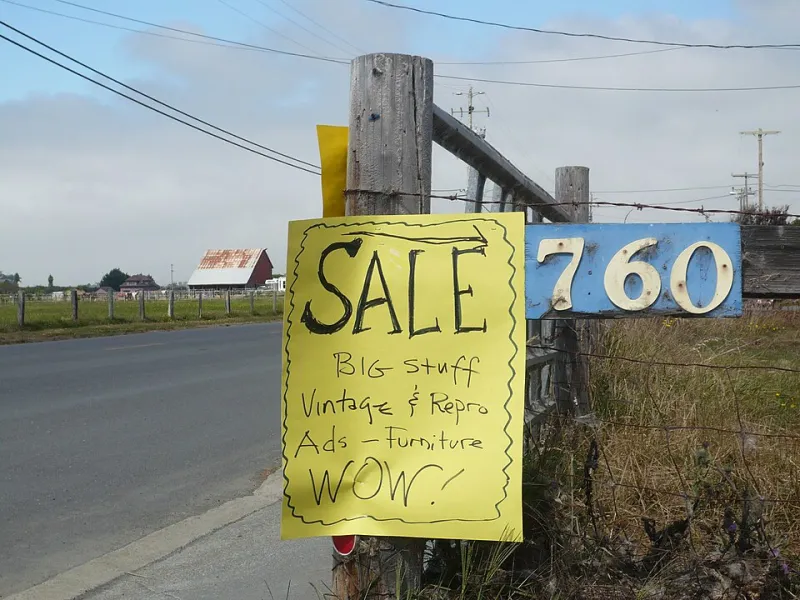
Photo: Ellin Beltz, CC BY-SA 3.0, via Wikimedia Commons
Garage sale stickers look like afterthoughts — a scrap of masking tape, a ballpoint scrawl, a dot of red sticker stock. But walk slowly past enough folding tables in 2026 and the tags start to read like a neighborhood’s public diary. They are price labels, yes, but they are also boundary lines, conversation starters, and tiny declarations about what a family thinks its castoffs are worth. The whole driveway becomes a temporary economy, and the sticker is its currency and its constitution. The handwriting matters as much as the number; a hurried scrawl says one thing, a careful label says another.
The Sticker Is a Small Public Notice
Most sellers are not pricing objects so much as writing a note to strangers. Fifty cents, firm is not merely math; it is a mood. It says: I have already done the emotional labor of deciding, and I would like to be done now. OBO — or best offer — is the opposite: a little flag of flexibility, an invitation to treat the table like a flea-market seminar. Somewhere between them sits the handwritten make offer, which sounds relaxed but often means the seller has no idea and is hoping you do. A sticker can be polite, tired, optimistic, or quietly final, all before anyone says a word.
Dots, Dashes, and the Grammar of Maybe
Colored dots are the punctuation. A yellow dot may mean half off after noon; a green dot may mean already paid; a red dot may mean do not ask. The code changes by driveway, which is part of the fun. Shoppers learn to read the table like a local dialect: a slash through a price means the item has been sold, a question mark means the seller is unsure, and a tiny TLC is a polite way of saying the thing needs love, glue, or a licensed electrician. NIB — new in box — is the sticker equivalent of a firm handshake. As is is the legal disclaimer. Works is hope with a plug on it.
Bundle Math and the Gentle No
Then there is bundle math, the informal arithmetic that turns three lamps, a crate of jars, and a garden hose into a single negotiable unit. Sellers often write $10 for all not because the math is clean but because they want the table to be lighter by lunch. Buyers, meanwhile, perform their own calculations: if one item is marked $3 and another $4, is $5 for both a reasonable opening? The sticker does not answer. That is the point. It leaves just enough room for a small, socially acceptable drama — the raised eyebrow, the shrug, the cash box opening with a satisfying click.
The Cash Box Meets the QR Code
In 2026, many sales still run on a cash box and a coffee can, but a laminated QR code may sit beside it. The sticker remains the star. A price tag written in Sharpie feels more negotiable than a barcode, and that is exactly why it survives. It signals that a human is behind the table and that the number can be discussed, even if the answer is no. The low-tech label has somehow become the most honest part of the transaction.
What the Prices Say About the Block
Driveway tags also reveal neighborhood economics without ever meaning to. A set of wine glasses marked $2 suggests a household clearing space; a child’s bike at $15 suggests a growth spurt; a box of tools with no prices at all suggests a seller who would rather talk than transact. In some yards, prices are rounded and generous; in others, every item carries a museum-style valuation. Neither is wrong. The stickers simply show how different households measure value — by replacement cost, by nostalgia, by how badly they want the driveway back by 2 p.m.
The Thrill Is in the Decoding
The real pleasure of a garage sale sticker is that it is never fully authoritative. It can be crossed out, amended, ignored, or replaced with a better offer. It is a price with a pulse. That may be why shoppers slow down for a table of mismatched mugs and mystery cables: they are not just looking for a bargain. They are reading a tiny handwritten newspaper about the block, one sticker at a time. And for fifty cents — firm — that is still a pretty good subscription.